
Shemu (Harvest Season)
Lasts 3 hours
While it lasts
All Floodplain Production Buildings in Province
 Additional 1t every cycle

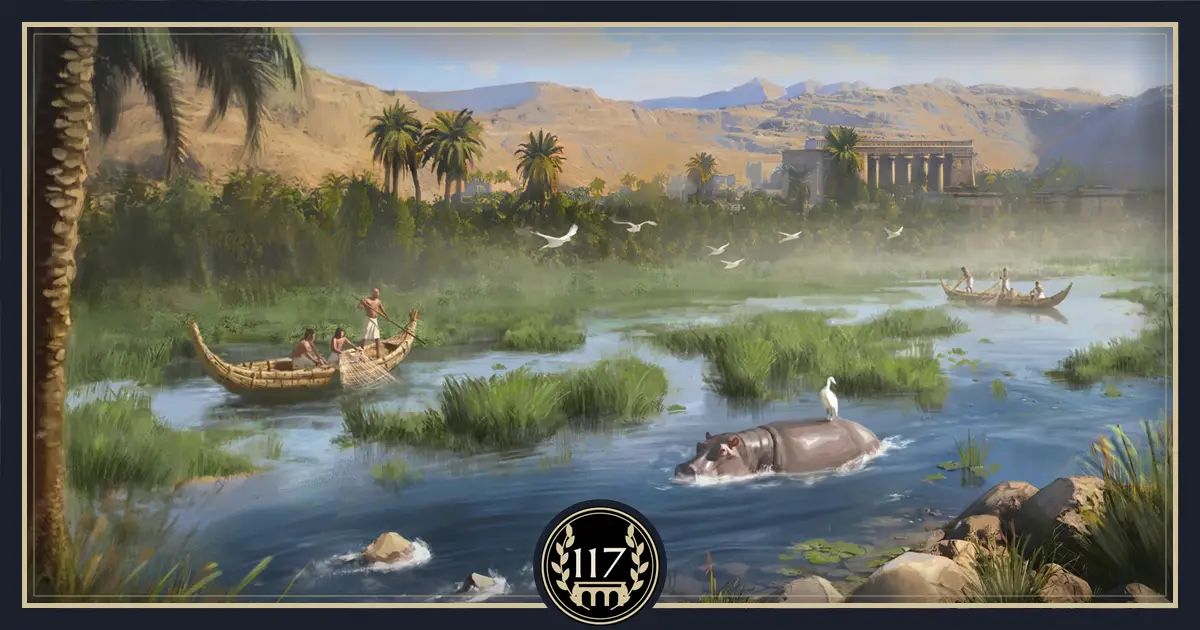
How parts of Anno 117 work, from the game’s own files: the harvest and flood of Aegyptus, granaries and rats, the volcano, Amphitheatre games, Hippodrome races, the Assembly and settlement rights.
How parts of the game work, from its own files: the seasons and granaries of Aegyptus, the volcano of Latium, the games of the Amphitheatre and the races of the Hippodrome, the Assembly and settlement rights, and every topic the game's advisors explain.
The seasons of Aegyptus come round in turn: Shemu (Harvest Season) for 3 hours, then Akhet (Flood Season) for 2 hours. A game starts in Shemu (Harvest Season), which lasts 2 hours the first time.
All Floodplain Production Buildings in Province
Additional 1t every cycle
All Floodplain Production Buildings in Province
 Productivity-75%
All Buildings in Province
 Health-2
 Fire Safety+2
Halves the penalty on productivity related to the flood season for all buildings located in the floodplains.
Once the farm goods of an island exceed what its granaries and depots can store, they overflow and attract rats. The game checks for rats at intervals; the more an island overflows, the likelier they come. An infestation lowers the Health of the buildings nearby, and from Medium up the rats carry goods off. How it goes on Easy, Medium or Hard:
 Rat Problemfor 15 minutes:Health -1 for the buildings nearbyRat Infestationfor 15 minutes:Health -2 for the buildings nearbyRat Plaguefor 15 minutes:Health -4 for the buildings nearby
Rats carry off no goods on Easy.
Rat Problemfor 30 minutes:Health -1 for the buildings nearby; rats carry off 50 to 100 tRat Infestationfor 30 minutes:Health -2 for the buildings nearby; rats carry off 100 to 200 tRat Plaguefor 30 minutes:Health -4 for the buildings nearby; rats carry off 200 to 300 tRat Problemfor 45 minutes:Health -1 for the buildings nearby; rats carry off 50 to 100 tRat Infestationfor 45 minutes:Health -2 for the buildings nearby; rats carry off 100 to 200 tRat Plaguefor 45 minutes:Health -4 for the buildings nearby; rats carry off 200 to 300 tThe volcano of Prophecies of Ash goes through these phases in turn, starting dormant. Its effects reach the whole province; while it is awake, tremors shake the land, and an eruption leaves deposits of obsidian behind.

Occasus is at rest.
Quarries and pits regularly provide obsidian.
Quarries in Province
Mines regularly provide obsidian.
Mines in Province
Volcanic ash has improved the quality of your soil, promoting plant growth.
Plantations in Province
Productivity+10%
Gases rise from the bowels of the earth. The occasional tremor startles the people of Latium from their sleep.
Quarries and pits regularly provide obsidian.
Quarries in Province
Mines regularly provide obsidian.
Mines in Province
Volcanic ash has improved the quality of your soil, promoting plant growth.
Plantations in Province
Productivity+10%Increased probability of tremors and earthquakes
Province Islands

Burning debris falls from the sky, the earth shakes. Work in the mines slows as the breath of the underworld issues from below. Nowhere is safe...
Underground tremors cause shafts to collapse, preventing work in the mines.
Mines in Province
Productivity-100%
The cold descends and nothing will grow.
Quarries and pits regularly provide obsidian.
Quarries in Province
Mines regularly provide obsidian.
Mines in Province
Volcanic activity is increasing the risk of fires, diseases and unrest.
All Buildings in Province
 Happiness-3Health-3Fire Safety-3
A mighty ash plume blots out the sun, halting plant growth.
Plantations in Province
Productivity-75%
The fertile ash makes for a spring unlike any other.
Quarries and pits regularly provide obsidian.
Quarries in Province
Mines regularly provide obsidian.
Mines in Province
Volcanic ash has improved the quality of your soil, promoting plant growth.
Plantations in Province
Productivity+10%Your people are glad the ashfall has finally ended.
Roman Residences in Province
Happiness+2The amphitheatre adds to your glory, unlocking powerful effects and fateful decisions. Held at the Amphitheatre. Every event adds Splendour to the monument, and higher tiers of Splendour open the grander events.

Games bound to draw the envy of other governors, featuring spectacular skirmishes, notable gladiators and hot-headed newcomers.

Games worthy of imperial attention, drawing spectators from all across the province. Featuring to-scale battles; expect famous gladiators and savage beasts.
 50,000 Denarii
 50 Patrician Workforce

The grand celebrations in honour of Neptune, hosting impressive historical re-enactments, and even simulated naval battles called naumachia.
100,000 Denarii100 Patrician Workforce Bread
 Wine
 Oysters with Caviar
 Roast Beef
 Bird Tongues in Aspic
 Weapons
 Armour
 Rope
 Sails
 Timber
 Clan Shields
 Tyrian Purple
 Cushions
 Fine Glass
 Amphorae
 Standing Lyres
Held at the Hippodrome. Every event adds Splendour to the monument, and higher tiers of Splendour open the grander events.

Invite four select chariot crews to compete in front of chanting crowds.
40,000 Denarii30 Patrician Workforce
The most thrilling and traditional of games. Screeching wheels and thunderous hooves reverberate across the province as six teams compete.
75,000 Denarii75 Patrician Workforce
Invite no less than eight potential champions from across the empire, to an occasion that will be carved onto obelisks and recounted in song.
120,000 Denarii125 Patrician WorkforceBreadWineOysters with CaviarRoast BeefBird Tongues in Aspic CheeseWeaponsArmourRope
 Horses
 ChariotsClan ShieldsTyrian PurpleFine GlassAmphoraeStanding Lyres
 LoungersWeaponsArmourRopeHorsesChariotsClan ShieldsTyrian PurpleFine GlassAmphoraeStanding LyresLoungers
Optional; they add to the Splendour the race wins.
Every island in Latium and Albion has an Assembly of 6 factions, whose seats come from the buildings below. Donate to a faction to win its support, once every 5 minutes; with a supermajority of 66.66% behind you, you can take the island over.
Province Islands
 Libertus Workforce+1
 Wader Workforce+1
Its strength: 1, and 1 more for every 10 seats.
Province Islands
 Belief+2
Its strength: 4, and 1 more for every 10 seats.
Province Islands
 Knowledge+2
Its strength: 4, and 1 more for every 10 seats.
Province Islands
 Prestige+2
Its strength: 4, and 1 more for every 10 seats.
Province Islands
Happiness+1Health+1Fire Safety+1Its strength: 5, and 1 more for every 10 seats.
Globally
Income+10Its strength: 0.5, and 1 more for every 10 seats.
Settling an island takes a settlement right. Governors start with some, as the game's settings decide, and earn more with each new Governor Rank. A right they are missing is bought from the Emperor, and each costs more than the last.
1,0002,0003,0005,0007,50010,00015,00020,00030,00040,00050,00075,000100,000150,000200,000300,000400,000500,000750,0001,000,0001,500,0002,000,0002,500,0003,000,0003,500,0004,000,0005,000,0006,000,0007,000,0008,000,0009,000,00010,000,00012,500,0007501,5002,2503,7505,6257,50011,25015,00022,50030,00037,50056,25075,000112,500150,000225,000300,000375,000562,500750,0001,125,0001,500,0001,875,0002,250,0002,625,0003,000,0003,750,0004,500,0005,250,0006,000,0006,750,0007,500,0007501,5002,2503,7505,6257,50011,25015,00022,50030,00037,50056,25075,000112,500150,000225,000300,000375,000562,500750,0001,125,0001,500,0001,875,0002,250,0002,625,0003,000,0003,750,0004,500,0005,250,0006,000,0006,750,0007,500,000What the game's advisors explain when a feature first comes up, topic by topic, in the game's own words.

Your residents have needs that are grouped into categories such as Food, Fashion or Public Services.
It is up to you to decide which needs you provide. For early residents, one need covers an entire category.
Once each category has been provided for, you can upgrade residences to the next tier.
Many production buildings affect the attributes of nearby buildings while they are actively producing.
Review the attribute effect of any public building at the top of its panel.
Choose carefully when placing buildings close to each other to max out benefit / mitigate risk.
Each Need that you fulfill per residence increases different attributes.
The most important ones are Income and Population.
Attributes can benefit your city. E.g. increasing your population will increase your workforce. Income will increase your wealth over time.
As the city grows, the demand for goods grows with it.
Check regularly if your residents' needs are fulfilled to mitigate economic impact.
Production Buildings require a road connection in order to receive and distribute goods.
Newly-produced Goods are delivered to the next Warehouse or Trading Post, or Production Building that can process them.
All Warehouses and Trading Posts on an island share the same storage. Goods in one Warehouse are available in all other Warehouses.
You can upgrade residences to follow the roman cultural template or instead allow local culture to develop. Each culture has its own unique needs.
You can mix different cultures in your city or focus entirely on the one you prefer.
Different characters might react to you differently depending on how much you Romanise a province.
Only the locals, the Kumatics, can build Nile boats. Unlike sailing ships, they are not impeded by the river's currents.
Some buildings can only be built in the marshes. Marshes are limited in space.
A few buildings, like the warehouse, can be built on solid ground or in the marshes.
Wooden roads can only connect to marsh buildings at specific points. The orientation of the buildings is important.
Most buildings cannot be built in the marshes.
You have the possibility to drain marshes and reclaim land that can be used to expand your city.
Drainage Channels need to be connected to a Sluice Gate (slot building) to drain water from the marshes.
Recruitment buildings allow you to recruit military units. Each unit class has unique strengths and weaknesses.
Encamp units to heal hitpoints and decrease maintenance cost.
Protect your villa. Walls and towers will keep most invaders at bay, though they can be destroyed by siege weapons such as onagers.
To distribute water you need an Aqueduct Source in a mountain slot, the aqueduct itself and also an Aqueduct Cistern that will distribute the water to its vicinity.
The water can only be distributed downhill. Choose a mountain slot high enough to transport the water to the lower part of the island.
Water is a limited resource. All buildings around a cistern benefiting from the aqueduct will consume water. Check the aqueduct menu where you can manage water consumption.
Provide Needs to your population that contribute to Income. The Income Attribute is the main way to gain Denarii.
Each residence contributes, so building more residences will increase your income.
Most buildings have maintenance costs which are a constant expense. You can pause buildings to reduce expenses. Ships and Troops have also maintenance costs.
In your Trading Post you can define which goods to sell to passing ships. This provides a good source of passive income and uses up goods you've over-produced.
The island will switch owners once the Villa is attacked and destroyed.
A frontal assault might not be the best approach. Find ways to flank other troops and to use troops that have an advantage over other type of troops.
Use Siege units to destroy defences from a distance.
Most buildings require Workforce to function. Different Workforce types may be needed depending on the building.
Workforce is derived from Population. The Resident Tiers define which workforce type you have available. So if you need Plebeian Workforce, grow your Plebeian Population.
To increase a Population Tier, build and upgrade residence of this tier and provide Needs that increase the Population Attribute.
High Prestige or Splendour attracts Honoured Guests. Select their ship or receive them automatically once the timer runs out.
With increasing Island Prestige, the rarity of specialists that you can receive increases, all the way up to the legendary rank.
Heroic specialists require Splendour. Monuments with higher Splendour tiers increase the chance of attracting them.

The Amphitheatre offers great benefits to all buildings within range.
Every event you host increases Amphitheatre Splendour, increasing the monument's attributes.
Splendour decreases over time if the Amphitheatre isn't in use. Keep hosting games to retain benefits.
Provide sufficient Needs for each category: you may upgrade a residence once the bar in its panel turns green. Turns golden once you provide surplus Needs.
Every additional fulfilled need unlocks bonus Attributes for its respective Need Category.
Bonus attributes depend on their Need Category and on how many Needs per category you oversupply. Review info tips to learn more.

Obsidian is a byproduct of pits and quarries. Research "Obsidian Gathering" to obtain it.
Latium's obsidian deposits are finite and replenish after each volcanic eruption.
Use obsidian to hire Caecilia's unique resource specialists, or to produce new researchable needs.
Volcanic rockfall occurs across the province and can damage buildings. You can pick up rockfall to gain obsidian.
Mines cannot operate during earthquakes. Active effects of any volcano phase can be found at the top of your screen.
Each eruption you survive increases the output of obsidian in pits and quarries in Latium.
Falling ash darkens the sky, impacting the productivity of farms and fisheries in Latium.
Latium's obsidian deposits are finite and replenish after each eruption.
Once a deposit is replenished, pits and quarries can resume the production of obsidian.
Volcanic winter has ended and its negative effects no longer apply. The volcano is at rest, though it may stir again someday...
All farms in Latium benefit from the fertile ash. Their productivity has increased!
Pits and quarries yield increased amounts of obsidian as a byproduct, obtained over various production cycles.
After three eruptions, Volcanic Soil reaches Level 3. Using research, you can unlock higher levels, up to a total of 5.
For each level of volcanic soil, your Latium farms receive +10% productivity. All obsidian deposits provide increased yields.
Effects related to Volcanic Soil Levels are permanent, unless you turn off the Volcano Game Setup. This will cause the levels to decrease over time.
Races increase Splendour. Your charioteer's performance influences the total gain.
Splendour ranks boost the attributes provided by the Hippodrome.
Splendour decreases over time if no races take place. You can automate the scheduling of races.
Preparing an amateur, quadriga or imperial race requires specific goods. Optional goods add Splendour to the winning pool.
Select a specialist to race: Their skill is represented by charioteer stats. These do not influence rarity or effects.
Every race your specialist participates in improves their charioteer stats, up to a personal maximum.
Each charioteer has four stats: Speed, Stamina, Reliability and Sprint. These are revealed after a charioteer's first race.
Stamina becomes relevant as the number of laps increases. Reliability prevents fluctuations in performance.
Sprint grants charioteers a temporary speed boost. Use the button in the Hippodrome panel to activate Sprint.

Green, irrigated farmland supports farms, wood and charcoal production.
The floodplains provide local building materials and allow for the trapping of wild animals.
The arid desert is best suited to construction. Once you unlock irrigation, you can transform the desert into farmland.
Aqueduct cisterns and channels can create new farmland. Place an aqueduct or water basin next to the river.
Aqueducts require Romanized population. Connected cisterns create circular irrigated zones.
Water Channels stem from your Aegyptian population. They create rectangular irrigated zones.
Life in the delta is defined by the river and its inundations: there is a bountiful harvest season and a less fruitful flood season.
Complete research to place farms in the floodplains. You can always place them on irrigated farmland.
The productivity of floodplain farms increases during harvest season and decreases during flood season. Stockpile these goods during harvest season!
Due to inundations, you may have an abundance of produce during harvest season, and shortages during flood season.
Granaries provide extra storage for agricultural produce. They can help mitigate fluctuations in supply.
Once agricultural produce exceeds the storage of a granary or depot, it attracts rats, lowering the Health of your entire city.
The pyramids are located next to Naukratis. Deliver the required goods to Heron's pyramid dock in time, or set up Trade Routes.
All governors contribute to the restoration of the pyramids. The higher your contribution, the better your reward.
Once restored, the pyramids fulfil a Public Service need for Chanters and Gymnasiarchs, regardless of who finished the task.
Settling Aegyptus is the privilege of trusted governors: Land here is divided into nomes, defined by the arms of the river.
The river's current is strong, slowing down sailing ships. The locals (Kumatics) can build Nile boats that travel the river swiftly.
Sailing ships are well-suited to export goods to other provinces. Add oars to minimize the impact of the river currents.


